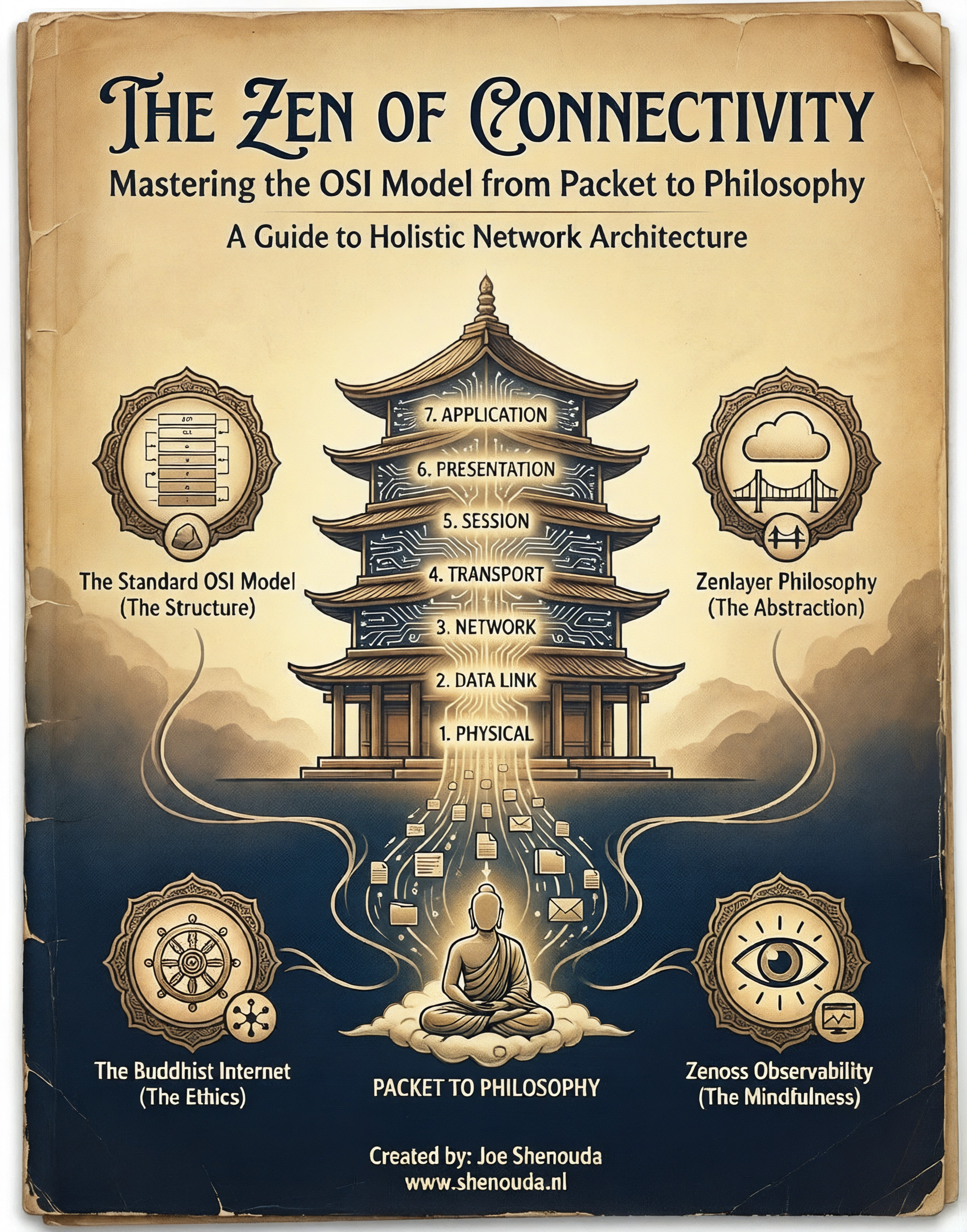
The Material World â The Standard OSI Model
1.1 The Pre-Standard Chaos: Before the Enlightenment
To understand the "Zen" of modern networkingâwhether that be the streamlined services of Zenlayer, the philosophical Eightfold Path of a Buddhist internet, or the deep observability of Zenossâwe must first understand the chaos that preceded order.
In the early days of computing, roughly the 1960s and early 1970s, the digital world was a fractured landscape of proprietary fiefdoms. If a corporation bought mainframe computers from IBM, they spoke SNA (Systems Network Architecture). If they bought from DEC (Digital Equipment Corporation), they spoke DECnet. These systems were monolithic and isolationist. A machine from one vendor could not effectively communicate with a machine from another without complex, expensive, and often unstable clumsy translators. The digital universe was not a network; it was a series of disconnected islands.
This period was characterized by what a network philosopher might call "Samsara"âa cycle of aimless wandering and suffering. Engineers were trapped in vendor lock-in, unable to scale or innovate because the fundamental language of communication was fragmented. There was no shared reality, no common ground upon which to build a global infrastructure.
The International Organization for Standardization (ISO) recognized this fundamental fragmentation. In the late 1970s, they began a project to define a universal standard for networking. The goal was audacious: to create a conceptual framework that would allow any computer system, regardless of its underlying architecture or manufacturer, to communicate with any other. This was the birth of the Open Systems Interconnection (OSI) model.
Published officially in 1984 as ISO standard 7498, the OSI model was not software. It was not a piece of hardware you could buy. It was a philosophy of structure. It broke down the impossibly complex task of "communication" into seven distinct, manageable layers. It transformed the chaotic monolith of networking into a structured hierarchy. While the TCP/IP model eventually won the war of practical implementation (becoming the actual protocol suite of the Internet), the OSI model remains the undisputed "Meditation Map" of the industry. It is the perfect theoretical construct that engineers use to diagnose, design, and understand the flow of data. It is the "Material World" we must master before we can transcend it.
1.2 The Seven Steps of Propagation: A Descent into Matter
The beauty of the OSI model lies in its verticality. Data does not just move horizontally from computer A to computer B; it must first travel vertically. It begins as an abstract idea in the software (Application Layer) and descends through the stack, becoming increasingly dense and material, until it is nothing but pulses of electricity or light (Physical Layer). Upon reaching the destination, it ascends again, shedding its material constraints to become information once more.
Let us walk this path, from the top down, examining the specific burden and function of each layer.
The Host Layers (Layers 7, 6, 5)
Layer 7: The Application Layer â The Surface of Interaction
This is the layer of interaction. It is the only layer that the human user (or the software process acting on their behalf) directly perceives. However, a common misconception is that Layer 7 is the application (like a web browser or an email client). It is not. Layer 7 is the protocols that the application uses to express its desires to the network.
When you click a link, your browser (the application) triggers HTTP (the Layer 7 protocol). If you send an email, you are engaging SMTP. This layer is responsible for identifying communication partners, determining resource availability, and synchronizing communication. In the context of "Zen," this is the layer of "Intent." It is where the desire to communicate is formed. But desire alone cannot move data.
Layer 6: The Presentation Layer â The Universal Translator
As data leaves the Application layer, it enters the Presentation layer. This is the domain of syntax and semantics. Computers communicate in different dialects; some read data in ASCII, others in EBCDIC. Some store integers in "big-endian" format, others in "little-endian." If Layer 7 is the intent to speak, Layer 6 is the grammar that ensures the message is intelligible.
This layer is also the guardian of secrecy. Encryption and decryption occur here (conceptually). When a secure socket layer (SSL/TLS) wraps your credit card data in a cryptographic shell, it is performing a Presentation layer function. It translates the "plaintext" of the application into the "ciphertext" of the network. It prepares the data for the dangerous journey ahead, formatting it into a standardized structure that can survive transport.
Layer 5: The Session Layer â The Manager of Dialog
The Session layer is the diplomat of the stack. Its primary role is to establish, manage, and terminate connections between applications. It distinguishes between different streams of data. If you are downloading a file, streaming music, and browsing a webpage simultaneously, it is the Session layer that ensures the music data doesn't end up in your spreadsheet.
It controls the dialogue: Who talks first? How long can they talk? What happens if the line goes dead? Layer 5 places "checkpoints" in the data stream. If a 100-megabyte transfer is interrupted at megabyte 50, the Session layer ensures you can resume from the middle rather than starting over. It brings order to the conversation, preventing the data streams from talking over one another.
The Media Layers (Layers 4, 3, 2, 1)
Layer 4: The Transport Layer â The Guarantor of Delivery
Here we cross a critical threshold. The upper layers are concerned with the content and meaning of the data. The lower layers are concerned only with moving it. Layer 4, the Transport Layer, bridges these worlds. It is responsible for end-to-end communication.
This is the home of the two great rivals of networking: TCP (Transmission Control Protocol) and UDP (User Datagram Protocol).
TCP is the meticulous perfectionist. It establishes a connection, numbers every segment of data, and demands an acknowledgement for every packet sent. If a packet is lost, TCP resends it. It guarantees reliability but at the cost of speed and overhead.
UDP is the "Zen" minimalist of transport. It sends data without establishing a connection and without checking if it arrived. It is fast, fluid, and assumes that if you missed a packet (like a frame in a video stream), itâs better to move on than to dwell on the past.
Layer 4 takes the large data chunks from the Session layer and breaks them into manageable "Segments." It is the logistics manager, ensuring that a massive file doesn't clog the pipe by chopping it into pieces that the network can handle.
Layer 3: The Network Layer â The Pathfinder
Once the data is segmented, it descends to Layer 3, the Network Layer. Here, the segments are encapsulated into "Packets." This layer is responsible for logical addressing and routing. The most famous resident here is the Internet Protocol (IP).
Layer 3 does not care about the content of the message; it cares about the destination. It is the GPS of the stack. It looks at the destination IP address and consults a routing table to decide the best path through the complex web of the internet. It deals with logical topologyâsubnets, gateways, and hops.
It is at Layer 3 that we see the first major abstraction of the physical world. An IP address is a logical construct; it is not tied permanently to a piece of hardware. It allows the network to be dynamic and flexible. However, this flexibility introduces the "Suffering of Latency." Every time a router inspects a Layer 3 packet to make a decision, milliseconds tick by.
Layer 2: The Data Link Layer â The Local Enforcer
We are now close to the metal. Layer 2, the Data Link Layer, is responsible for node-to-node transfer. While Layer 3 routes data across the world, Layer 2 moves data to the device sitting right next to it.
Here, packets are encapsulated into "Frames." The addressing scheme changes from logical IP addresses to physical MAC (Media Access Control) addresses. A MAC address is burned into the network interface card of the device. It is immutable. It is the "fingerprint" of the machine.
Layer 2 is divided into two sub-layers:
LLC (Logical Link Control): Talks to Layer 3 above.
MAC (Media Access Control): Talks to Layer 1 below.
This layer handles the arbitration of the medium. If two devices try to talk on the same wire at the same time, a collision occurs. Layer 2 protocols (like CSMA/CD in early Ethernet) manage this chaos, enforcing rules on who can speak and when. In the context of Zenoss monitoring (which we will explore in Chapter 4), Layer 2 is critical because it represents the physical reality of the connection. You can have perfect routing logic (Layer 3), but if the switch port is blocked (Layer 2), nothing moves.
Layer 1: The Physical Layer â The Raw Reality
Finally, we reach the bottom. The Physical Layer. Here, there are no frames, no packets, no files, and no meanings. There is only the raw bit streamâones and zeros.
Layer 1 defines the physical specifications: the voltage levels that represent a "1" versus a "0," the shape of the connector (RJ45, LC/SC fiber), the frequency of the light pulses in a fiber optic cable, and the pin layouts. It is the hardware. It is the copper wire, the fiber optic glass, and the radio waves of Wi-Fi.
This is the most vulnerable layer. A backhoe cutting a fiber line, a loose cable, or electromagnetic interference from a microwave ovenâthese are Layer 1 problems. In the Zen OSI philosophy, Layer 1 represents the "body." Without a healthy body (physical infrastructure), the mind (software) cannot function.
1.3 Encapsulation: The Matryoshka Doll of Data
The movement through these layers is defined by a process called Encapsulation. As data moves down the stack, each layer adds a "Header" (and sometimes a "Trailer") to the data received from the layer above.
Imagine sending a letter (Data).
Layer 7/6/5 write the letter and put it in an envelope (Payload).
Layer 4 marks the envelope with a tracking number (TCP Segment Header).
Layer 3 puts that envelope inside a larger courier bag and labels it with the destination address (IP Packet Header).
Layer 2 puts the courier bag inside a shipping container and locks it (Ethernet Frame Header/Trailer).
Layer 1 loads the container onto a truck (Bits on the wire).
When the data reaches the receiver, the process reverses (Decapsulation). The truck is unloaded, the container opened, the courier bag removed, the envelope extracted, and finally, the letter read. This rigorous wrapping and unwrapping is computationally expensive. It is the "heavy lifting" of networking.
1.4 The Map vs. The Territory: TCP/IP vs. OSI
It is essential to acknowledge a historical irony. While we are studying the OSI model as our path to enlightenment, the internet effectively runs on the TCP/IP model. The TCP/IP model is a condensed version of OSI, combining Layers 5, 6, and 7 into a single "Application" layer, and Layers 1 and 2 into a "Network Access" layer.
Why do we stick to the seven layers of OSI? Because it offers higher resolution. When troubleshooting a "slow network," saying the problem is in the "Application layer" of TCP/IP is too vague. Is it a formatting issue (Presentation)? A session timeout (Session)? Or a protocol error (Application)? The OSI model provides the granularity needed for true diagnosis. It is the superior tool for understanding, even if TCP/IP is the tool for implementation.
1.5 The "Suffering" of Complexity
Why do we need a "Zen" approach to this model? Because the standard OSI model, while brilliant, is inherently fraught with friction.
Every time a packet moves from one layer to another, there is processing overhead. Every router hop adds latency. Every conversion from optical light to electrical copper introduces the potential for error (jitter). In a traditional, hardware-heavy network, managing these seven layers requires distinct expertise: cabling guys for Layer 1, switch admins for Layer 2, routing architects for Layer 3, and developers for Layer 7.
This siloed approach leads to operational "Dukkha" (suffering/unsatisfactoriness). When a user says "the internet is slow," the Layer 3 engineer blames the Layer 7 code, and the Layer 2 admin blames the Layer 1 cabling. There is no holistic view.
This complexity sets the stage for the solutions we will explore in the coming chapters. We will see how Zenlayer attempts to abstract Layers 1-3 into a fluid service, removing the physical burden from the user. We will see how the Buddhist Internet attempts to purify the intent at Layers 6 and 7. And we will see how Zenoss attempts to watch the entire stack simultaneously, bringing awareness to the suffering so that it can be resolved.
The Material World is the starting point. It is rigid, physical, and complex. But it is only by understanding the weight of these layers that we can appreciate the lightness of Zen.
The Way of Simplicity â The Zenlayer Philosophy
2.1 The Philosophy of Abstraction: Hiding the Machinery
In Chapter 1, we descended into the "Material World" of the OSI model. We saw the copper wires, the blinking lights of the switches, the routing tables, and the rigid headers of TCP/IP. It was a world of immense complexity, where a single loose cable at Layer 1 could bring down a global application at Layer 7. If Chapter 1 was about the reality of the machine, Chapter 2 is about the human desire to ignore it.
The history of computing is, in essence, the history of abstraction. In the earliest days, programming meant physically re-wiring the machine (Layer 1). Then came Assembly language, which abstracted the binary. Then came high-level languages like C, then Python, and now, low-code/no-code platforms. In networking, the trajectory is identical. We are moving away from the "Iron Age" of racking servers and crimping cables toward the "Cloud Age" of clicking buttons.
01011001 ERRORMACHINERY
ZEN
This drive for abstraction is not just about laziness; it is a pursuit of "Zen." In a philosophical sense, Zen emphasizes the direct experience of reality without the interference of cluttered thought. In networking, this translates to the user experiencing the service (the video, the game, the data) without the interference of the infrastructure. The goal of the modern network architect is to make the network invisible.
When a user streams a movie, they do not want to think about the Border Gateway Protocol (BGP) routing decisions happening at Layer 3. They do not want to know about the handshake at Layer 5. They just want the movie to play. The "Zen" of networking is achieved when the complexity of the OSI model is fully sublimated into a seamless experience. This brings us to the first of our three "Zen" interpretations: the philosophy behind the company Zenlayer.
2.2 Defining "Zen" in Business: The Zenlayer Approach
The company Zenlayer provides a perfect case study for this booklet because its very name bifurcates the central conflict of IT: the tension between the "Zen" (Simplicity/Experience) and the "Layer" (Complexity/Infrastructure).
The "Layer": Acknowledging the Burden
The "Layer" in Zenlayer refers directly to the OSI stack we just analyzed. It is an acknowledgement that, no matter how much we abstract, the physical world still exists. Data centers occupy real estate. Servers consume electricity. Undersea cables get eaten by sharks. You cannot wish away Layer 1.
Many cloud providers try to pretend the hardware doesn't exist, selling a "serverless" dream that often breaks down when performance issues arise. The "Zenlayer" philosophy starts with a grounding in reality: "The Layers exist, and they are heavy." It respects the physics of the OSI model. It acknowledges that if you are in Mumbai and your server is in Los Angeles, Layer 1 physics (the speed of light) dictates a latency of at least 200 milliseconds. No amount of software meditation can change the speed of light.
The "Zen": The User Experience
If "Layer" is the problem, "Zen" is the solution. In this context, Zen is defined as the removal of friction. It is the application of flexible consumption models to rigid hardware.
Traditionally, building a global network was the opposite of Zen. It involved:
Negotiation: Months of contracts with ISPs in foreign jurisdictions.
Logistics: Shipping hardware through customs (often getting stuck for weeks).
Deployment: Flying engineers to the site to rack and stack servers.
Maintenance: Waking up at 3:00 AM to replace a failed hard drive.
This is "Samsara"âthe cycle of suffering. The "Zen" approach replaces this with a portal. The user logs in, selects a city, chooses a server type, and clicks "Deploy." Behind the scenes, the messy reality of Layers 1, 2, and 3 is handled by the provider. The user stays at Layer 7, interacting with a clean interface. The complexity is not destroyed; it is assumed by the provider so the user can find peace.
2.3 The Rise of the Edge: Reducing the Stress of Distance
In Buddhism, suffering is often caused by attachment and distance from the truth. In networking, suffering is caused by distance from the user. This suffering is measured in Latency (the time it takes for data to travel) and Jitter (the variance in that time).
The centralized cloud model (where all data lives in massive hubs like "us-east-1" in Virginia) creates stress. If a user in Indonesia tries to play a fast-paced game hosted in Virginia, the packets have to traverse half the globe, passing through dozens of routers (Layer 3 hops) and undersea repeaters (Layer 1 boosts). The experience is laggy, disjointed, and frustrating. The "Zen" is broken.
The solution is Edge Computing. This is a core tenet of the Zenlayer philosophy. Instead of forcing the user to travel to the data, the data travels to the user.
Imagine the network as a spiderweb. The centralized cloud is the center of the web. The "Edge" is where the web attaches to the wallâthe point closest to the outside world. By placing servers at the Edge (in local ISPs, in city-center data centers), we reduce the physical distance the light must travel.
Layer 1 Benefits: Shorter cables mean less attenuation and faster transit.
Layer 3 Benefits: Fewer router hops mean less processing time and fewer chances for a packet to be dropped.
Layer 7 Benefits: The application feels "instant."
Edge computing is the architectural equivalent of mindfulness: being present in the "here and now." It localizes the experience. A user in Mumbai connects to a server in Mumbai. The interaction is immediate. The stress of the long journey is removed.
2.4 Software Defined Networking (SDN): Mind Over Matter
How do we manage this dispersed, complex network without losing our minds? If we have servers in 50 cities, do we need 50 network engineers managing 50 different switch consoles? That would be chaos.
The answer is Software Defined Networking (SDN). SDN is perhaps the most "Zen" technology to emerge in the last decade because it explicitly separates the "Mind" (Control Plane) from the "Body" (Data Plane).
In a traditional router (Legacy Networking), the brain and the muscle are in the same box. The router decides where to send packets (Brain/Control Plane) and actually pushes the packets out the port (Muscle/Data Plane). This means if you want to change the policy for your network, you have to log into every single router and update its brain individually.
SDN decapitates the router. It removes the brain and puts it in a centralized software controller (the "SDN Controller"). The physical switches and routers become "white boxes"âmindless bodies that simply obey orders.
The Controller (The Meditating Mind): This software sits above the network. It sees the entire topology as a single holistic map. It makes high-level decisions: "Prioritize video traffic from Tokyo to Singapore."
The Data Plane (The Acting Body): The physical switches receive these instructions and execute them instantly.
This allows for Intent-Based Networking. The engineer expresses an intent ("Secure this traffic"), and the SDN controller translates that intent into thousands of specific flow rules for thousands of specific switches. It is the ultimate manifestation of "Zen" in engineering: doing more by doing less. The engineer sits in stillness (at the console), and the entire network rearranges itself around them.
2.5 Case Study: The Tale of Two Architects
To illustrate the difference between the Traditional OSI approach and the Zen OSI approach, let us look at a hypothetical scenario involving two technical architects: Architect Samsara and Architect Nirvana.
Both work for gaming companies that have just released a hit mobile game in Brazil. They are based in San Francisco. They need to scale infrastructure immediately to handle the influx of Brazilian players.
The Path of Architect Samsara (Traditional)
Analysis: Samsara looks at the OSI model and realizes he needs Layer 1 presence in São Paulo.
Procurement: He contacts a hardware vendor. They quote a 6-week delivery time for servers. He argues, stresses, and pays an expedite fee.
Colocation: He contacts a data center in São Paulo. He has to negotiate a 12-month lease for a rack. Lawyers get involved. Layer 7 (Application) is waiting on Layer 8 (Politics).
Network: He orders a dedicated circuit (MPLS) from an ISP. It takes 90 days to provision.
The Result: By the time the servers arrive and the network is lit up, 3 months have passed. The gamers in Brazil experienced 200ms latency, got frustrated, and quit. The game failed. Architect Samsara is suffering.
The Path of Architect Nirvana (Zen/Edge/SDN)
Analysis: Nirvana logs into an Edge Cloud portal (like Zenlayer).
Action: She selects "São Paulo" from the map. She selects "Bare Metal Instance." She chooses an image with her game server software pre-loaded.
Connectivity: She uses the portal's SDN feature to create a virtual private connection between her San Francisco database and the new São Paulo game servers. The SDN controller handles the routing logic instantly.
Deployment: She clicks "Provision."
The Result: Ten minutes later, the servers are online. The SDN network is routing traffic. Brazilian players connect to the local São Paulo servers with 20ms latency. The game is a hit. Architect Nirvana goes to lunch.
Conclusion
This case study highlights the core value of the "Zenlayer" interpretation of the Zen OSI model. It is not about ignoring the layers; Architect Nirvana still used servers (Layer 1), switching (Layer 2), and routing (Layer 3). But she consumed them as a service rather than a chore.
She mastered the "Way of Simplicity." But simplicity is only one path to enlightenment. In the next chapter, we will leave the corporate boardroom and enter the monastery, reimagining the OSI layers not as products to be consumed, but as ethical steps on the path to a righteous internet. We turn our gaze to the "Buddhist Internet."
The Digital Eightfold Path â The Buddhist Internet
3.1 Reimagining the Stack: From Protocol to Principle
In the previous chapter, we explored the "Zen" of business efficiencyâusing abstraction to reduce the suffering of complexity. While effective, that approach is ultimately utilitarian. It asks, "How can I make this work faster?" In this chapter, we pivot to a deeper, more radical interpretation of the "Zen OSI" concept: the "Buddhist Internet."
Here, we do not ask how to make the network faster; we ask how to make it righteous.
The connection between Buddhism and Cybernetics is not as tenuous as it might seem. Both disciplines are obsessed with systems, causality, and the cessation of suffering. In Buddhism, the path to enlightenment is the Noble Eightfold Pathâa set of eight practices that lead to the end of suffering (Dukkha). In networking, we too suffer. We suffer from downtime, from security breaches, from technical debt, and from chaotic codebases.
Some tech philosophers have proposed that we can map the Eightfold Path directly onto the layers of our digital existence. This creates a manifesto for the "Ethical Architect." It transforms the OSI model from a technical specification into a code of conduct.
3.2 The Path of Wisdom (PrajñÄ): The Code
The first division of the Eightfold Path concerns Wisdomâthe intellectual understanding of the nature of reality. In networking, this corresponds to the design and software layers (Layers 5-7). It is about the "Mind" of the network.
1. Right Understanding (SammÄ-diá¹á¹hi) â Knowing the Topology
In Buddhism, Right Understanding is the realization of the Four Noble Truths. It is seeing the world as it actually is, not as we wish it to be.
In networking, Right Understanding is the discipline of Truth in Documentation. A major source of operational suffering is the gap between the network diagram and the network reality. The architect believes the firewall permits traffic on port 443. The reality is that a legacy rule blocks it. This delusion causes outages.
Right Understanding demands:
Accurate Topology: Maintaining a map of the network that reflects the physical reality.
Acknowledging Technical Debt: Admitting that the "temporary hack" implemented three years ago is now a structural load-bearing pillar.
Root Cause Analysis: When a system fails, we do not just reboot it (ignoring the truth); we investigate why it failed. We seek the origin of the suffering.
A network engineer practicing Right Understanding does not guess. They verify. They understand that a "cloud" is just someone else's computer, and they design with the acceptance that failure is inevitable (impermanence).
2. Right Thought (SammÄ-saá¹ kappa) â Security by Design
Right Thought refers to the intentions behind our actions. It encompasses thoughts of non-violence and benevolence. In the digital realm, this is Security and Privacy by Design.
The "Wrong Thought" in networking is malicious or negligent architecture. It is the collection of user data without consent (Dark Patterns). It is the creation of backdoors for easy access that eventually get exploited by hackers.
Right Thought dictates:
Zero Trust Architecture: We do not blindly trust a device just because it is inside our perimeter. We verify every request.
Benevolent Architecture: We design systems that protect the user, not exploit them. We use encryption (TLS) not just to meet compliance, but because we genuinely intend to safeguard the sanctity of the communication.
The Intent to Serve: The network exists to transport information, not to manipulate it.
3. Right Speech (SammÄ-vÄcÄ) â The Purity of Protocols
Right Speech is the abstention from lying, divisive speech, and idle chatter. In the OSI model, this is the domain of Protocols and APIs (Layer 6/7).
Computer systems "speak" to one another constantly. If their speech is ambiguous, communication fails.
Standardization as Truth: Using standard protocols (HTTP/2, JSON, XML) rather than proprietary, obfuscated binary blobs. Standard protocols are "truthful" speech because they are open, documented, and universally understood.
Clear Error Handling: When a server fails, "Right Speech" demands it return a clear 500 Internal Server Error with a descriptive payload, rather than failing silently or returning a misleading 200 OK with an error in the body.
Avoiding "Idle Chatter": This is the principle of efficiency. Do not send a 5MB JSON payload when a 50KB payload will do. Bloated code consumes bandwidth and energy unnecessarily. It is digital noise.
4. Right Action (SammÄ-kammanta) â Ethical Conduct
Right Action is about moral behaviorâabstaining from killing, stealing, and sexual misconduct. In the cyber domain, this translates to Cybersecurity Ethics and Net Neutrality.
White Hat vs. Black Hat: The hacker who finds a vulnerability has a choice. Right Action is "Responsible Disclosure"âalerting the vendor so they can fix it. Wrong Action is selling the exploit on the dark web or using it to steal data.
Net Neutrality: A network practicing Right Action treats all packets equally. It does not throttle the traffic of a competitor (killing). It does not prioritize the traffic of a wealthy partner over a non-profit. It respects the sanctity of the data stream.
DDoS and Cyber Warfare: The ultimate violation of Right Action is the Denial of Service attackâthe intentional destruction of another's ability to communicate. The Zen Architect builds defenses against this but never engages in it.
3.3 The Path of Discipline (SÄ«la): Operations
The second division of the path concerns ethical conduct and mental discipline. In networking, this maps to the operational realityâthe daily grind of keeping the lights on (Layers 1-4).
5. Right Livelihood (SammÄ-ÄjÄ«va) â Green Computing
Right Livelihood means earning a living in a way that causes no harm. In the context of the internet, this is the most pressing physical challenge we face: Energy and E-Waste.
The internet is not a cloud; it is a coal furnace. Data centers consume roughly 1-2% of the world's total electricity. Every Instagram like, every ChatGPT query, and every streamed movie burns carbon.
Sustainable Power: The Zen Architect chooses data centers powered by renewable energy (hydro, wind, solar).
Hardware Lifecycle: Avoiding the cycle of "planned obsolescence." Extending the life of servers and switches rather than discarding them every three years reduces the toxic e-waste in landfills.
Algorithmic Efficiency: Writing inefficient code is an environmental crime. A loop that consumes twice as much CPU as necessary burns twice as much coal. Right Livelihood demands code that is lean and respectful of the planet's resources.
6. Right Effort (SammÄ-vÄyÄma) â Load Balancing and Scaling
Right Effort is the balance between exertion and relaxation. It is avoiding the extremes of laziness and burnout. In IT infrastructure, this is Load Balancing and Auto-Scaling.
A server that is running at 100% CPU utilization is in a state of suffering. It is "burning out." It will eventually crash (mental breakdown). Conversely, a server running at 1% utilization is "lazy"âit is a waste of resources and electricity.
Right Effort is the "Middle Way":
Load Balancing: Distributing traffic evenly across a cluster of servers so that no single node bears too much weight. This is the communal sharing of the burden.
Auto-Scaling: The infrastructure breathes. When traffic spikes (effort is needed), new servers spin up. When traffic drops (time to rest), servers spin down. The system adapts dynamically to the needs of the moment, never straining, never wasting.
7. Right Mindfulness (SammÄ-sati) â Observability
Right Mindfulness is the quality of "bare attention." It is being fully present and aware of the current moment. In networking, this is the domain of Logging and Monitoring.
We will explore the tools for this (like Zenoss) in Chapter 4, but here we define the philosophy. A "mindless" network is one where errors happen in the dark. A disk fills up, and no one knows until the database crashes. A port starts flapping, and no one sees it until the user complains.
Right Mindfulness means:
Comprehensive Logging: Every event, every error, and every transaction is recorded. The system is self-aware.
Real-Time Alerting: The operator is notified as the suffering arises, not hours later.
Contextual Awareness: Knowing not just that CPU is high, but which process is driving it. It is the deep introspection of the digital self.
8. Right Concentration (SammÄ-samÄdhi) â Quality of Service (QoS)
The final step is Right Concentrationâsingle-pointedness of mind. It is the ability to focus on one object to the exclusion of all others. In networking, this is Quality of Service (QoS) and Bandwidth Shaping.
The internet is a noisy place. Voice-over-IP (VoIP) packets compete with Netflix downloads and Windows updates. If the network tries to do everything at once with equal priority, the sensitive voice call will break up (the mind wanders).
Right Concentration is the discipline of prioritization:
Traffic Shaping: The router identifies the critical traffic (the voice call) and gives it a dedicated lane. It pushes the "distractions" (the Windows update) to the side, allowing them to proceed only when there is spare capacity.
Dedicated Bandwidth: In critical systems (like remote surgery or stock trading), we create "tunnels" of absolute focus (MPLS or dedicated fiber) where no outside noise can enter. The network achieves a state of flow.
3.4 Interconnectedness: PratÄ«tyasamutpÄda
To conclude our philosophical tour, we must address the core Buddhist concept of PratÄ«tyasamutpÄda, or Dependent Origination. This doctrine states that all phenomena arise in dependence upon other phenomena. Nothing exists in isolation.
This is the fundamental truth of the Microservices Architecture.
In the old days of the "Monolith," the application was one giant block of stone. Today, modern applications are composed of thousands of tiny, interconnected services. The "Login Service" depends on the "User Database," which depends on the "Storage Volume," which depends on the "Network Fabric."
The Butterfly Effect: A retry storm in a small, insignificant service (Service A) can overload the database (Service B), which causes the checkout page (Service C) to time out, which causes the company to lose millions of dollars.
Interbeing: The network engineer must understand that there is no "us" versus "them." The developer's code is the network's traffic. The network's latency is the application's user experience. They "inter-are."
The Buddhist Internet is not a religious concept; it is a systems theory. It teaches us that because everything is connected, our ethics, our code, and our hardware must be aligned. If we neglect one layerâif we practice Right Speech (good code) but Wrong Livelihood (dirty energy)âthe system remains in Samsara.
In the next chapter, we will move from the philosophy of mindfulness to the tools of mindfulness. We will examine how Zenoss provides the digital eyes and ears necessary to practice Right Mindfulness in a complex, chaotic world.
The Watchful Eye â Mindfulness via Zenoss
4.1 The Art of Observability: Beyond Simple Monitoring
In Chapter 3, we established "Right Mindfulness" as a core tenet of the Buddhist Internetâthe necessity of being fully aware of the present moment. In the realm of engineering, this awareness has a name: Observability.
It is crucial to distinguish Observability from traditional Monitoring, as the difference is akin to the difference between looking and seeing.
Monitoring is binary and reactive. It asks: "Is the server on?" "Is the disk full?" It is a dashboard of red and green lights. It tells you that something is wrong.
Observability is fluid and investigative. It asks: "Why is the server slow?" "What is the internal state of the system based on its external outputs?" It allows you to explore the "unknown unknowns."
For the Zen OSI model, we need more than just a red light. We need deep insight. This is where platforms like Zenoss enter the narrative. Zenoss is not just a monitoring tool; it is a "Unified Service Assurance" platform. In our philosophical framework, it acts as the Digital Pineal Glandâthe third eye that sees the invisible connections between the layers.
The challenge of modern infrastructure is noise. A single data center generates millions of log lines, metrics, and traps every hour. To the untrained eye, this is chaos. To the "Watchful Eye" of Zenoss, this is data waiting to be transformed into wisdom. The goal is to move from a state of "Alert Fatigue" (where the engineer ignores the pager because it beeps too much) to a state of "Operational Enlightenment" (where every alert is meaningful and actionable).
4.2 ZenPacks and Extensibility: Extending the Senses
Human beings experience the world through sensesâsight, sound, touch. A network monitoring platform experiences the world through protocolsâSNMP, SSH, WinRM, and API calls.
In the Zenoss ecosystem, these sensory organs are called ZenPacks. A ZenPack is a plugin that teaches the core system how to talk to a specific device or layer of the OSI model. Without the appropriate ZenPack, a router is just a black box. With the ZenPack, the system can see inside the chassis, monitor the temperature of the silicon, and count the packets on the wire.
Layer 2 Monitoring: Grounding the Awareness
We previously discussed how Layer 2 (Data Link) is the "body" of the network. It is where the MAC addresses live and where physical switching occurs. Paradoxically, this is often the biggest blind spot in modern monitoring. Tools tend to focus on Layer 3 (IPs) and Layer 7 (Applications) because they are easier to reach.
Zenoss places a heavy emphasis on Layer 2 observability (often via the Layer2 ZenPack). Why is this critical for "Zen"? Because physical reality matters.
The Mac Address Table: By querying the bridge-MIBs of switches, Zenoss builds a catalog of exactly which physical device is plugged into which physical port.
Spanning Tree Protocol (STP): STP is the mechanism that prevents loops in a network. If STP fails, a broadcast storm ensues, bringing the network to its knees. Monitoring the state of STP (Blocking vs. Forwarding ports) is essential to preventing this chaos.
Neighbor Discovery: Using protocols like LLDP (Link Layer Discovery Protocol) and CDP (Cisco Discovery Protocol), the system maps the physical adjacencies. It knows that Switch A is connected via a fiber cable to Router B.
This grounding prevents "phantom problems." When an application fails, the Layer 2 monitor can instantly confirm: "The cable is unplugged." It cuts through the noise of software debugging to reveal the physical truth.
Layer 3 and Beyond: The Nervous System
Moving up the stack, ZenPacks allow for deep inspection of the routing layer.
Route Flapping: If a route to a destination appears and disappears ten times a minute, it causes massive jitter. Zenoss tracks the stability of the routing table.
Interface Statistics: It is not enough to know an interface is "Up." We need to know its health. Are there CRC errors? (Indicates a bad cable). are there "Runts" or "Giants"? (Indicates malformed packets).
The extensibility of ZenPacks represents the Buddhist concept of UpÄya (Skillful Means). The monitoring system is not rigid; it adapts to the environment. If you introduce a new, obscure storage array into your data center, you install the ZenPack for that array. You grow a new "sense" to perceive that specific reality.
4.3 Event Management as Meditation: Filtering the Noise
The greatest enemy of mindfulness is distraction. In a Network Operations Center (NOC), distraction takes the form of Event Storms.
Imagine a core router fails. This is a single event. However, this router connects 50 switches. Those 50 switches all send "Link Down" alerts. Those 50 switches host 1,000 servers. Those 1,000 servers all send "Unreachable" alerts. Those 1,000 servers host 5,000 application containers. They all scream "Connection Timeout."
Suddenly, the operator is bombarded with 6,051 red alerts. Panic ensues. This is the opposite of Zen.
Zenoss approaches this through an Event Management pipeline that mimics the meditative process of clearing the mind.
1. Ingestion and Normalization (Listening): First, the system accepts inputs from everywhere: Syslog, SNMP traps, Windows Event Logs, API hooks. It normalizes them into a standard format. It translates the gibberish of different vendors into a common language.
2. Deduplication (Focusing): If a server sends the same "High CPU" trap every 10 seconds, the operator does not need to see 360 rows of the same text. The system "deduplicates" these into a single event line with a counter: "High CPU (Count: 360)." This reduces the visual noise by 99%.
3. Correlation (Understanding): This is the magic. Because the system possesses a model of the network (Right Understanding), it can correlate these seemingly disparate events.
It looks at the 6,051 alerts from our previous example and applies logic:
"I see 5,000 app failures."
"I see 1,000 server failures."
"I see 50 switch failures."
"I see 1 router failure."
"I know that the apps live on the servers, which connect to the switches, which connect to the router."
The system suppresses the 6,050 symptom alerts and presents the operator with exactly one root cause alert: "Core Router Down."
This is Dharana (concentration). It strips away the illusion (the symptoms) to reveal the truth (the root cause). It transforms a panic-inducing storm into a single, actionable task.
4.4 Model-Based Monitoring: The Digital Twin
How does the system know that the app depends on the server? It requires a Model.
Most monitoring tools are "flat." They is just a list of devices. Zenoss is "dimensional." It builds a directed graphâa Digital Twinâof the entire IT environment.
This brings us back to the concept of PratÄ«tyasamutpÄda (Interconnectedness) from Chapter 3.
The Dependency Graph: In the Zenoss database (ZODB), objects are linked. A vSphere Host object contains Guest VM objects. A Guest VM object runs Service objects. A Service object serves Business Function objects.
Dynamic Modeling: This model is not static. The system scans the network periodically (modeling intervals) to update the graph. If a VM moves from one host to another (vMotion), the model updates. If a new switch is added, the model expands.
This modeling is the technical implementation of "Interbeing." It acknowledges that the health of the "Checkout Page" is inextricably linked to the health of the "SAN Storage Array" three layers down.
When an engineer looks at a device in Zenoss, they see a "Service Impact" view. They can see exactly which business services will fail if a specific fan in this specific chassis stops spinning. It contextualizes the hardware. It gives the silicon a purpose.
4.5 Predictive Maintenance: The Oracle
Finally, true mindfulness leads to foresight. If one is truly observant of the present patterns, one can predict the future.
Traditional support is Reactive: "It broke, now I fix it."
Zen support is Proactive: "It is going to break, so I will adjust it."
This is the domain of AIOps (Artificial Intelligence for IT Operations). By storing historical performance data (trends), the system can project future states.
Capacity Planning: "Based on the growth trend of the last six months, the /var partition on the database server will reach 100% capacity in 14 days."
Anomaly Detection: "This server usually runs at 20% CPU on Tuesdays. Today it is at 60%. It is not 'broken' (the threshold is 90%), but it is 'wrong'. Something has changed."
This allows the engineer to act before the suffering arises. They can expand the disk volume today to prevent the crash in two weeks. This is the ultimate goal of the Zen OSI model: a state of No Incidents. A network that is so perfectly observed and tuned that it never actually breaks; it simply is adjusted.
Conclusion: The Watchful Eye
Zenoss, and tools like it, provide the rigorous discipline required to maintain the philosophy we have discussed.
It respects the Material World (Layer 1/2 monitoring).
It enables the Zenlayer abstraction (by managing the complexity so humans don't have to).
It enforces the Eightfold Path (through Right Mindfulness and Right Understanding).
We have now traversed the entire landscape: from the cables, to the business models, to the ethics, and finally to the tools. In the final chapter, we will synthesize these disparate elements into a unified persona: The Enlightened Architect.
The Enlightened Architect â Synthesis
5.1 The Holonic Network: Beyond Silos
We have traveled a long road. We began in the mud of the Physical Layer and ascended to the cloud. Now, we arrive at the destination. It is no longer just a "Network Engineer" standing here, but the Enlightened Architect.
To understand this persona, we must reject the "Silo Mentality." The Storage team cares only about disks, the Network team only about packets. This is organizational schizophrenia. The Enlightened Architect views the network as a Holarchy.
Coined by Arthur Koestler, a "holon" is something that is simultaneously a whole and a part. A router is a whole system, but a part of the network. The Enlightened Architect does not say, "The network is fine, it's the app's fault." They say, "The system is suffering."
5.2 The Role of AI and Automation: The Mechanical Monk
As we look to the future, we see the rise of the "Self-Driving Network." Artificial Intelligence (AI) promises a world where networks heal themselves.
Scenario: A fiber cut occurs. The AI detects the latency spike (Mindfulness), spins up new instances (Right Effort), and updates routes (Right Action) instantly. The human engineer doesn't even wake up.
This is the "Mechanical Monk." It meditates on the data streams 24/7. However, the Zen Architect approaches this with caution. If the AI handles everything, the human loses touch with reality. We use AI for augmentation, not abdication.
5.3 The Zen Architect's Manifesto
1. Simplicity is the Ultimate Sophistication: Aggressively prune complexity. Seek the "Empty Mind" (Mushin) in your topology.
2. Intent Must Match Implementation: Use Infrastructure as Code (IaC). The map must be the territory.
3. Silence the Noise: Practice "Alert Hygiene." Treat the pager as a temple bellâit should only ring when it is time to wake up.
4. Design for Impermanence: Accept that hardware fails. Build "Anti-Fragile" systems.
5. Respect the Physics: Do not fight the speed of light. Align digital desires with physical reality.
5.4 Layer 8: The Human Layer
Finally, we reach the top of the stack. Layer 8 is often referred to jokingly as "Politics" or "The User." The Enlightened Architect flips this script. Layer 8 is not the problem. Layer 8 is the purpose.
We build networks so a grandmother can video chat with her grandson. We do it so a refugee can access their bank funds. The network is the central nervous system of humanity.
The ultimate realization of the Zen OSI model is that Technology is Compassion. If we build a perfect network for unethical purposes, we have practiced "Wrong Livelihood."
Conclusion: The Empty Packet
In Zen Buddhism, you cannot fill a cup that is already full. The network is a vessel. A packet is "empty" until we fill it with meaning. It can carry a virus, or it can carry a love letter. The job of the Architect is to build the vessel, but the value comes from the humans who use it.
We have reached the end of the stack. The session is closed. The connection is terminated. But the insight remains.
Layer 1: Ground yourself in reality.
Layer 2: Connect with your neighbors.
Layer 3: Find the best path.
Layer 4: Guarantee delivery.
Layer 5: Manage the dialogue.
Layer 6: Speak the truth.
Layer 7: Express the intent.
Layer 8: Serve the human.
This is the Zen of Connectivity.